

Business Taxes, Family Taxes, General Information, General Tax Topics, Self Employed, Small Business, Tax Debt, Tax Deductions, Tax Planning, Tax Reduction, Uncategorized

Fraud by Tax Preparer Creates Big Trouble for Client

trouble.jpg

Is your tax preparer honest? You likely see indicators one way or the other. If your tax preparer commits fraud that benefits you, that can create trouble for you. In our Chicago South Loop tax preparation office,  we see a lot of clients that need tax debt relief. Many tax debt cases happen because a taxpayer unknowingly hired a dishonest tax preparer to file their tax return.  Let’s see how this works in real life.

Situation

The government indicted, tried, and convicted tax preparer Gregory D. Goosby of 30 fraud violations where he willfully aided and assisted in the preparation of false and fraudulent income tax returns.

Vincent Allen engaged Goosby to prepare his tax returns before Goosby’s fraud conviction. Allen gave Goosby his W-2, 401(k) statement, mortgage interest statement, and property tax statements. Goosby used those deductions but also added others, claiming false and fraudulent deductions for charitable contributions, meals and entertainment, and pager and computer expenses.

Guys with Guns 

Two special agents from the IRS’s Criminal Investigation Division interviewed Allen concerning Goosby’s preparation of his income tax returns. Allen agreed with the IRS that the deductions were false and fraudulent, but both the IRS and Allen blamed Goosby. The IRS did not charge Allen with intent to evade taxes (fraud).
Schedule-button-nbor click here to call us 1-855-743-5765.

Statute of Limitations

In general, the IRS has three years from the date you file your tax return to audit it and propose adjustments. In the case of fraud, the IRS can audit your return at any time. There is no limit on how far back the IRS can go.

In this case against Allen, the first-ever case of this nature decided by the Tax Court, the fraud was committed by Goosby, the preparer, not by Allen, the taxpayer. So the Tax Court had to decide whether the fraud by the tax preparer extended the statute of limitations on the client’s return.

And that’s exactly what the Tax Court decided in this precedent-setting case. The tax preparer’s fraud extends the statute of limitations for fraud to the client even when the client is not charged with fraud. This means that if your tax preparer fraudulently prepares your return and you file it, the law extends the period during which the IRS can audit that tax return from the usual three years to forever.

Allen Was Lucky

Although Allen may not have felt lucky after he paid his lawyer fees and also handed over $10,000 in taxes, the IRS did not charge him with fraud and the court did not make him pay the 75 percent fraud penalty on the taxes due.
Schedule-button-nbor click here to call us 1-855-743-5765.
Beware

Using a dishonest tax preparer is a mistake. When the IRS catches the dishonest preparer, it likely catches you, too. And as the Tax Court has now ruled, fraud is fraud, and that opens your tax return up to IRS examination forever.

Protect yourself. Do not engage dishonest tax preparers. With Howard Tax Prep LLC, you will always have an honest tax preparer. We will always do our best to help you lower your taxes, but we will never cheat.

Although we’ve given you the basics, this is not an all-inclusive article. Should you have tax debt help questions, need Chicago business tax preparation, business entity creation, business insurance, or business compliance assistance please contact us online, or call our office toll free at 1-855-743-5765 or locally in Chicago or Indiana at 1-708-529-6604. Make sure to join our newsletter for more tips on reducing taxes, and increasing your wealth.

Schedule-button-nb

Never miss another tip again! Join our newsletter, to receive tax reduction/wealth building tips delivered right to your inbox!


newsletter

Business Taxes, Family Taxes, General Information, General Tax Topics, Self Employed, Small Business, Tax Debt, Tax Deductions, Tax Planning, Tax Reduction, Uncategorized

DID YOUR CPA REALLY FILE YOUR TAXES?

warning
Here in our Chicago South Loop Tax Preparation office, we’ve seen an increase in the number of people that have paid CPA’s to file their taxes, only to find that their taxes were never filed! Many people aren’t aware of the fact that their taxes haven’t been filed until they receive a letter or notice from the IRS requesting tax returns for the years in questions.
While you can file a complaint against professional tax preparers, the IRS still holds individual taxpayers responsible for ensuring that their tax returns were filed. Because individual taxpayers are responsible for filing their returns (and for what’s on their returns) we recommend that every taxpayer request a copy of their tax return transcript every 2-3 years. Keep reading to find out how to access your tax return transcript.
4 Ways to Get IRS Transcripts

1.) ONLINE: Access the IRS online system at  Get Transcript Online . You will need to have the following:

  • A wireless phone IN YOUR NAME.
  • Most recent tax return.
  • Account number from a credit card, mortgage, home equity loan/ line of credit or auto loan.

2.) BY MAIL: If you’re unable to register online, or you prefer not to use Get Transcript Online, you may order a tax return transcript and/or a tax account transcript using Get Transcript by Mail Please allow 5 to 10 calendar days for delivery.

newsletter

3.) BY PHONE: call 800-908-9946. Please allow 5 to 10 calendar days for delivery.

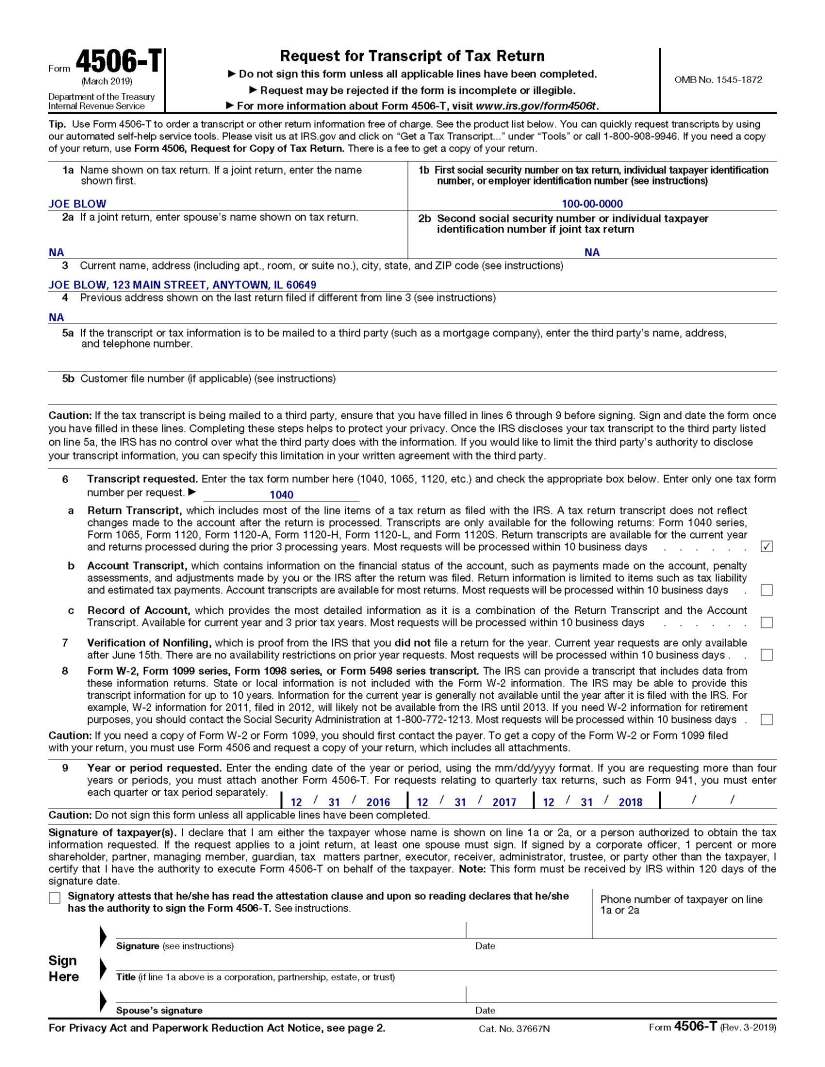
4.) BY FAX/MAIL: Complete Form 4506-T, Request for Transcript of Tax Return to 855-298-1145, unless you live in Maine, Massachusetts, New Hampshire, New York,
Pennsylvania, Vermont. If you live in one of the aforementioned states, you will fax your form to 855-821-0094. 
We’ve included a sample of how to complete form 4506 below.

f4506T Transcript Tax Return EXAMPLE_Page_1.jpg

Although we’ve given you the basics, this is not an all-inclusive article. Should you have tax debt help questions, need Chicago business tax preparation, business entity creation, business insurance, or business compliance assistance please contact us online, or call our office toll free at 1-855-743-5765 or locally in Chicago or Indiana at 1-708-529-6604. Make sure to join our newsletter for more tips on reducing taxes, and increasing your wealth.

Schedule-button-nb

Never miss another tip again! Join our newsletter, to receive tax reduction/wealth building tips delivered right to your inbox!

newsletter

Business Taxes, Family Taxes, General Information, General Tax Topics, Self Employed, Small Business, Tax Deductions, Tax Planning, Tax Reduction, Uncategorized

How to Handle Multiple Rental Activities and the 199A Deduction

apartment

In our  Chicago tax preparation office we often prepare real estate investor taxes. With the fairly new tax laws, there’s still a lot of confusion out there around your rental activity and Section 199A. Your Section 199A considerations multiply when you have multiple rental activities. Here’s what you need to consider:

  • Are your rental activities multiple trades or businesses, or one trade or business?
  • Can you aggregate the rentals for Section 199A purposes? Do you want to?
  • How does the Section 199A rental safe harbor impact your Section 199A deduction if you use it?

Whether your rental activities are each a trade or business, or they constitute one trade or business, is inherently based on the facts of your particular situation. The IRS also believes that multiple trades or businesses will generally not exist within an entity unless it can use different methods of accounting for each trade or business under the Section 466 regulations. These regulations explain that you can’t consider a trade or business separate and distinct unless you keep a complete and separable set of books and records for that trade or business.

This determination is an important factor for you if any one rental activity (taken individually) doesn’t rise to the level of a trade or business, but all the rental activities (viewed collectively) do rise to the level of a trade or business. One of the factors the IRS looks to when determining whether a rental activity is a trade or business is the number of properties rented.

Aggregation

The Section 199A regulations allow you to aggregate multiple trades or businesses such that you treat the aggregated group as one trade or business for determining your Section 199A deduction. This is an important consideration if one or more of your rental businesses have insufficient wages or unadjusted basis in assets (UBIA) to get the maximum Section 199A deduction for that property.
Schedule-button-nb
The final regulations tell us you can aggregate, in most circumstances, provided that the rental activities share centralized administrative functions, such as accounting, legal, and human resources functions. The big wrinkle is the type of rental business: you generally can’t aggregate residential rental businesses and commercial rental businesses with each other because they aren’t the same type of property.

Rental Safe Harbor

Along with the final regulations, the IRS gave you an optional safe harbor to deem your rental activities as qualifying for the Section 199A deduction. The safe harbor isn’t the best strategy because most rentals qualify as a trade or business anyway.
Although we’ve given you the basics, this is not an all-inclusive article. Should you have tax debt help questions, need Chicago business tax preparation, business entity creation, business insurance, or business compliance assistance please contact us online, or call our office toll free at 1-855-743-5765 or locally in Chicago or Indiana at 1-708-529-6604. Make sure to join our newsletter for more tips on reducing taxes, and increasing your wealth.

Schedule-button-nb

Never miss another tip again! Join our newsletter, to receive tax reduction/wealth building tips delivered right to your inbox!

newsletter

Business Taxes, Family Taxes, General Information, General Tax Topics, retirement planning, Self Employed, Small Business, Tax Planning, Uncategorized

Backdoor Roth IRA Opportunities Still Available After TCJA

backdoor

Good news. The Tax Cuts and Jobs Act (TCJA) did not harm the backdoor Roth strategy.

As you likely know, the Roth IRA is a terrific way to grow your wealth with a minimum tax downside because you pay the taxes up front and then, with the proper holding period, pay no taxes after that.

But if you earn too much, you’re completely barred from contributing to a Roth IRA unless you can use the backdoor Roth technique, which involves making a nondeductible contribution to a traditional IRA and then rolling that money into a Roth.
Schedule-button-nbThe backdoor Roth strategy has been around for a good nine years, and it has experienced no trouble that we are aware of, so we think it’s a good strategy. We also like the recent notations in the legislative history and the comments from the IRS spokesperson that show approval of the strategy.

Keep in mind that with some planning, you can avoid any taxes on the rollover. For example, if you have an existing traditional IRA, you can move those monies to your qualified plan to avoid having the backdoor strategy trigger some taxes. And if you have no traditional IRA, the nondeductible contribution to the traditional IRA and the subsequent rollover to the Roth IRA triggers no taxes.

Although we’ve given you the basics, this is not an all-inclusive article. Should you have tax debt help questions, need Chicago business tax preparation, business entity creation, business insurance, or business compliance assistance please contact us online, or call our office toll free at 1-855-743-5765 or locally in Chicago or Indiana at 1-708-529-6604. Make sure to join our newsletter for more tips on reducing taxes, and increasing your wealth.

Schedule-button-nb

Never miss another tip again! Join our newsletter, to receive tax reduction/wealth building tips delivered right to your inbox!

newsletter

Business Taxes, Family Taxes, General Information, General Tax Topics, Self Employed, Small Business, Tax Deductions, Tax Reduction, Uncategorized

Deduct Your Costs of Sponsoring Sports Teams

woman athletes playing soccer

In our south loop Chicago tax preparation office, when we prepare small business tax returns, we are often asked if a company can deduct the costs of sponsoring a sports team. Have you wondered what it takes to deduct the costs of sponsoring a sports team? What if you play on the team? Could you pay for the team travel expenses?

Revenue Ruling 70-393 states that the monies spent to outfit and support a sports team are similar to monies spent on other methods of advertising; accordingly, you may deduct them as business expenses for federal income tax purposes.

In the Strong case, Strong Construction Co. Inc. advertised its business primarily through either word of mouth or athletic sponsorships. As part of the athletic sponsorships, the corporation paid for the uniforms, logo design, hats, T-shirts, sweatpants, coats, bags, and pants for all players on its sponsored teams (broomball, softball, wrestling, etc.). The court ruled that the expenses were ordinary and necessary business expenses and that Strong could deduct them as advertising or promotion.
Schedule-button-nb
In the Bower case, James Bower sponsored the Lafayette Bower Housing Hustlers basketball team, and he was both an assistant coach and a player. As the Hustlers’ sponsor, Bower paid for the team’s travel, lodging, food, promotions, AAU fees, tournament fees, gym rental, and uniforms. The court noted that Bower’s sponsorship increased his commodity brokerage commissions and generated additional clients; accordingly, the court ruled that Bower’s sponsorship expenses were deductible business expenses.

Although we’ve given you the basics, this is not an all-inclusive article. Should you have tax debt help questions, need Chicago business tax preparation, business entity creation, business insurance, or business compliance assistance please contact us online, or call our office toll free at 1-855-743-5765 or locally in Chicago or Indiana at 1-708-529-6604. Make sure to join our newsletter for more tips on reducing taxes, and increasing your wealth.

Schedule-button-nb

Never miss another tip again! Join our newsletter, to receive tax reduction/wealth building tips delivered right to your inbox!

newsletter